
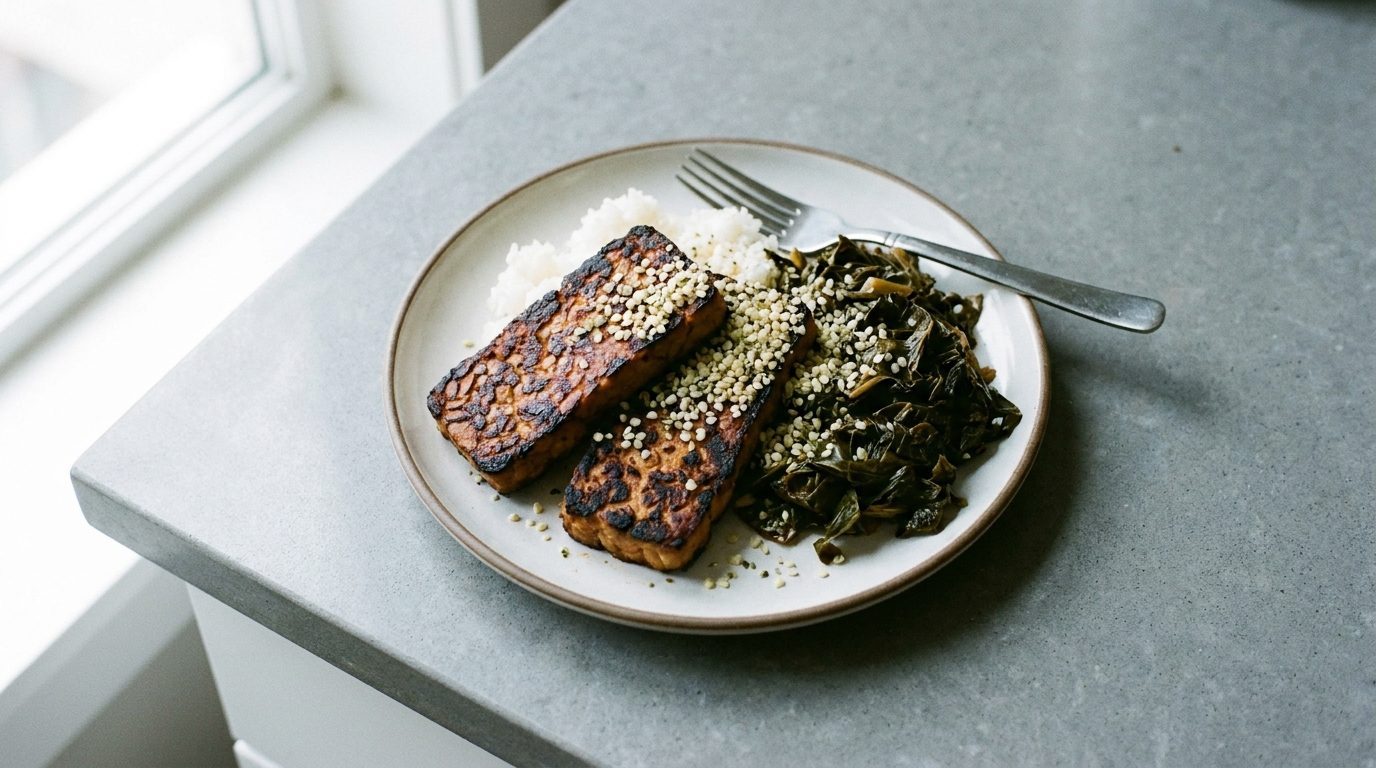
Holding your numbers on the bar while losing fat is a narrower job than most cutting advice admits. Three things protect strength in a deficit — protein intake, rate of loss, and how you train — and every food decision matters mainly through how well it serves those three.
Why strength drops in a deficit, and why it usually is not muscle
Muscle tissue is lost slowly. When lifts wobble three weeks into a cut, the culprit is almost always something faster-moving. Muscle glycogen drops when carbohydrate drops, and glycogen brings water with it, so the same muscle is literally less full and less springy. Recovery between sessions slows. Sleep often gets worse, particularly on aggressive deficits. Motivation flattens, and a lift attempted half-heartedly is a lift missed.
There is also a mechanical piece nobody warns you about: lose enough body mass and the leverages change, especially in bench press and squat, where your own tissue was doing a small amount of the work. That is a real, permanent-ish trade, not a failure of your diet.
The practical implication is that a bad training week in a deficit is a signal to check fuel and sleep, not to panic about catabolism.
Protein goes up, not down
Strength athletes at maintenance are generally advised to eat somewhere between 1.6 and 2.2 grams of protein per kilogram of body weight per day. In a deficit, the recommendation moves toward and past the top of that range — commonly around 2.0 to 2.4 grams per kilogram, with leaner lifters in steeper deficits sitting at the higher end.
Protein is doing two jobs at once here. It signals repair and helps preserve lean tissue while total energy is short, and it is the most satiating macronutrient, which matters enormously when you are hungry for eight weeks straight. Spread it across three to five feedings of roughly 20 to 40 grams rather than stacking it at dinner; distribution is more useful than heroics at one meal.
How fast is too fast
A common and sensible guideline is roughly 0.5 to 1 percent of body weight per week. The leaner and more advanced you already are, the more you should sit at the slow end — there is less fat available to give up, so the body looks elsewhere.
Faster than that and the trade-offs stack: worse sessions, worse sleep, more hunger, and a higher share of the loss coming from places you wanted to keep. If the scale is dropping faster than planned and your lifts are sliding with it, adding food back is the intervention, not more discipline. Periods spent eating at maintenance in the middle of a long cut are a legitimate tool, not a failure of will.
Which form of hemp is worth its calories
Hemp is often discussed as a single food, but in a deficit the differences between its forms are the whole point. Calories are the scarce resource, and each form spends them differently.
| Form | Mostly | Best use when calories are tight |
|---|---|---|
| Hulled hemp seeds (hearts) | Fat plus complete protein, very little fibre | Measured portions for minerals and flavour. Roughly 170 calories and 10 grams of protein per 30 grams, so measure rather than pour. |
| Hemp protein powder | Protein and fibre, much of the fat removed | The workhorse. More protein per calorie than the hearts, and the retained fibre helps appetite. |
| Hemp oil | Fat only | A dressing and a flavour, not a cutting tool. Treat it as a garnish you account for. |
| Whole, unhulled hemp seed | Fat, protein and considerable fibre | Bulk and chew, where the texture makes a smaller meal feel like a bigger one. |
Two honest caveats. Hemp protein is complete but relatively modest in leucine and lysine compared with whey or soy, and in a deficit the margin for sloppy protein quality is thinner than usual — pair it with dairy, soy or a blended powder rather than asking it to anchor every feeding alone. And the hearts are genuinely calorie-dense, which is a virtue when you are struggling to eat enough and a liability when you are not.
What hemp does offer in a cut is minerals per calorie. Magnesium, iron and zinc are exactly the nutrients that quietly get scarce when total food volume falls, and a measured spoonful on a meal buys a lot of them cheaply.
Train to keep what you are protecting
The training rule in a deficit is simple: keep intensity, trim volume. Heavy sets are the signal that tells your body to hold onto strength, so keep loading near your usual top-end percentages even if the total number of sets comes down. Volume is where fatigue accumulates, and fatigue is what you cannot afford to accumulate on reduced energy.
Expect personal bests to wait. A cut is a phase for maintaining capability, not extending it, and the lifter who accepts that comes out the other side with their numbers intact and something left in the tank for the next building block.
A checklist for the week your lifts wobble
- Sleeping under seven hours? Fix that before touching the diet.
- Carbohydrate low the day before the session? Move some of the day's carbohydrate into the pre-training meals.
- Losing faster than 1 percent of body weight per week? Add food back.
- Training volume crept up while calories came down? Cut sets, not intensity.
- Protein actually hitting the target, or only in theory? Count it for three days and find out.
Run the cut like a project with a defined end: a target rate of loss, a protein number you actually track, top sets you refuse to give up, and a date when you go back to eating for growth. Weigh the hemp hearts instead of pouring them, use the powder when you need protein rather than calories, and treat a bad session as information about fuel and sleep before you treat it as a verdict on your muscle. More on protein targets, recovery and everyday eating in the article library.